When the body listens to vibrations
Sometimes, the right frequency is all it takes for the body to slow down. Nowadays, when most of us are caught between stress, tension, and a lack of time for ourselves, more and more experts are asking the question: How can we help the body regenerate without complicated explanations and strenuous exercise?
Vibroacoustic resonance (VAT) is the answer to this need. It uses a simple but powerful tool—low-frequency sound vibrations that can literally tune the body and mind.
What is vibroacoustic resonance and why does it have such a profound effect?
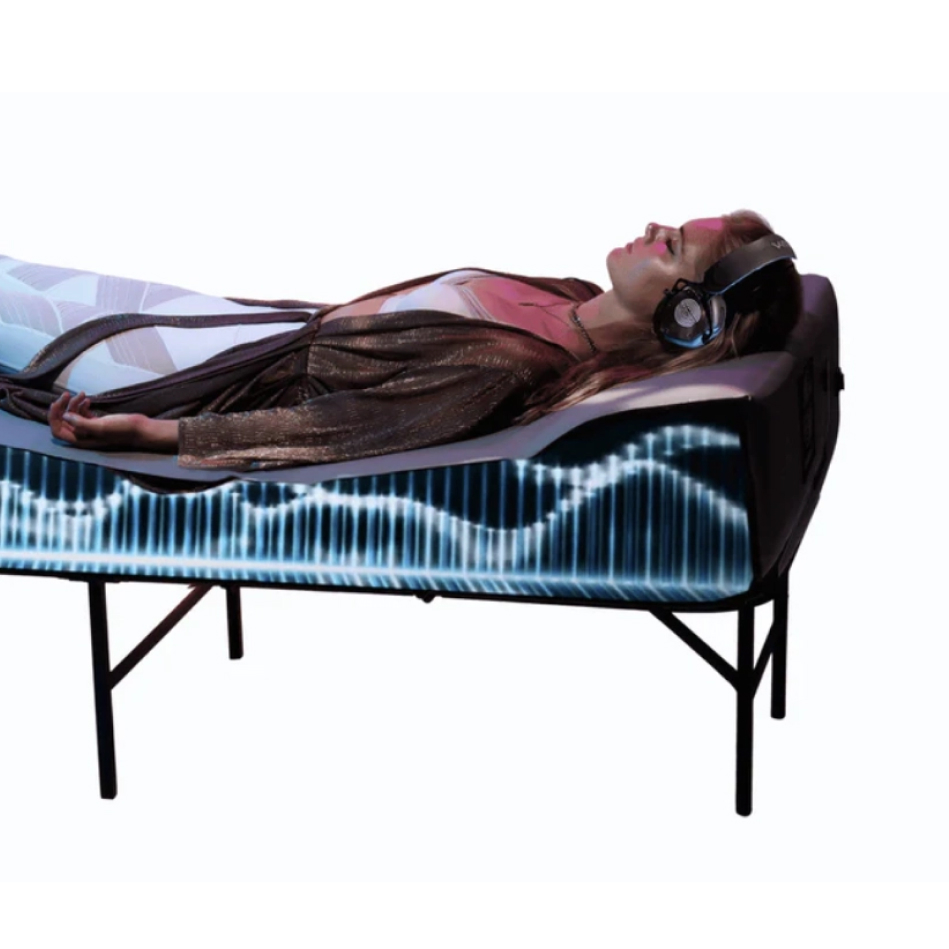
Vibroacoustic resonance is not just a pleasant experience. It is a method that transmits vibrations in the range of 30–120 Hz to the body using specially designed devices (couches, chairs, mats).
These vibrations cause resonance in soft tissues, fluids, and nerve structures.
Resonance activates Pacini corpuscles – receptors that send signals of safety and calm to the brain. This results in neurophysiological calming without the need for conscious activity. This is particularly beneficial for people suffering from high levels of stress, chronic stress, or psychosomatic problems.
Unlike other approaches, VAT does not require talking, movement, or concentration—the client simply lies down, perceives, and breathes. The frequency takes care of the rest.
What does VAT bring?
Practical experience and research confirm that vibroacoustic resonance:
- relieves tension in muscles and the nervous system,
- increases blood circulation and promotes regeneration,
- reduces pain (e.g., back, neck, menstrual, fibromyalgia),
- regulates stress and anxiety,
- improves sleep, mood, and emotional stability,
- activates the hormone oxytocin, which strengthens feelings of security and trust,
- works even with people who are unable to cooperate verbally,
It is used, for example, in rehabilitation, neurology, psychotherapy, and in healthcare facilities.
Therapy without words. But with a profound impact.
Vibroacoustic resonance acts as a natural language of the body that requires no explanation. And that is precisely where its power lies – it allows even those who do not normally have access to it to experience deep relaxation.
It is also effective where other techniques fail – for people who are exhausted, overworked, anxious, or psychosomatically reactive. Its effect is rapid, non-invasive, and supported by neuroscientific explanations.
Conclusion
VAT is not a substitute for therapy—it is a support and a calming foundation. At a time when the body is often the last to be given space, resonance offers effortless calm.
Perhaps now is the time to tune in—not through words, but through frequencies.
Sources
http://vibroacoustics.org/FrequencyInfo/Research%20Articles/Wigram.Vat.Thesis.pdf
https://www.researchgate.net/publication/258172758_Contemporary_Vibroacoustic_Therap y_Perspectives_on_Clinical_Practice_Research_and_Training
https://www.researchgate.net/publication/318852281_Vibroacoustic_Treatment_for_Chroni c_Pain_and_Mood_Disorders_in_a_Specialized_Healthcare_Setting
You can find the entire article here:
1. WHAT SCIENCE SAYS – VIBROACOUSTIC RESONANCE – AN IMPRESSIVE THERAPY (2)