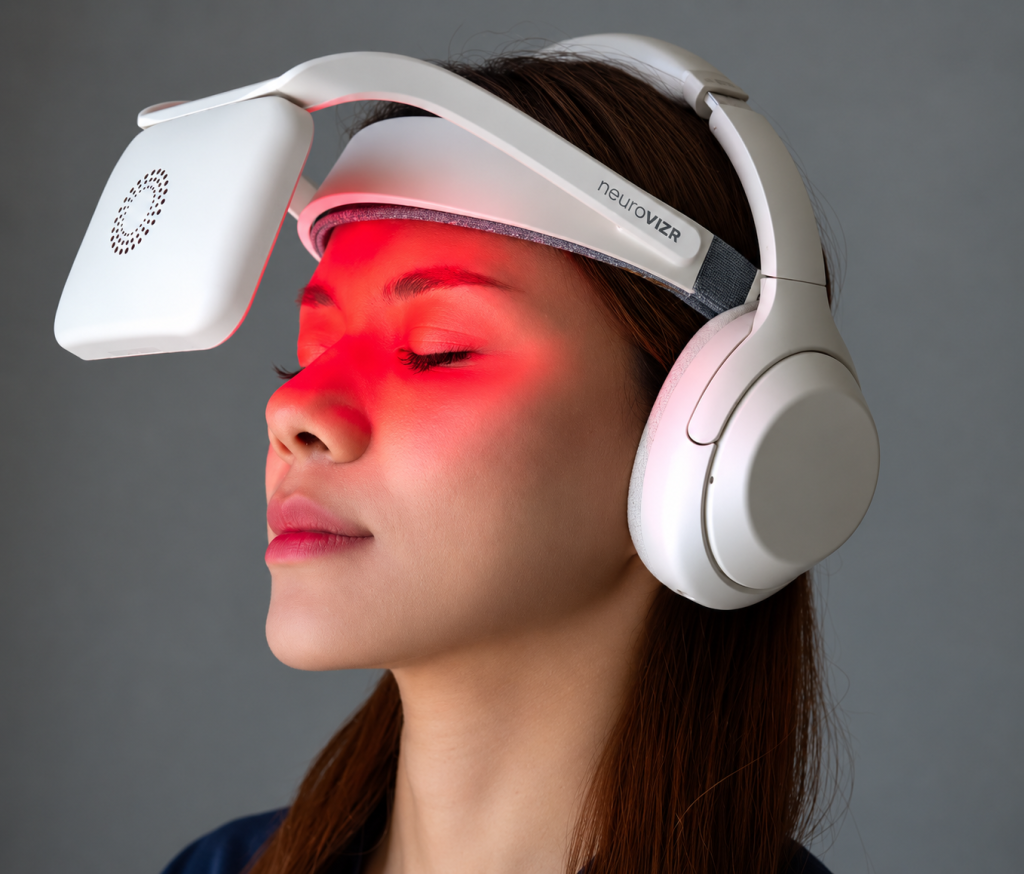
Depression is one of the most common and serious mental illnesses today. Although there are a number of treatment options available, conventional pharmacotherapy and psychotherapy do not provide sufficient relief for some patients. This is where transcranial magnetic stimulation (TMS) comes to the fore—a modern, non-invasive method that targets the brain circuits associated with mood regulation.
Contents
- What is transcranial magnetic stimulation (TMS)?
- What types of TMS are there?
- Which areas of the brain does TMS target?
- The biological basis of depression
- How TMS affects the brain in depression
- Who is TMS suitable for?
- Conclusion
- Scientific sources
What is transcranial magnetic stimulation (TMS)?
TMS is a non-invasive method of brain stimulation in which short magnetic pulses are used to influence the activity of nerve cells in precisely defined areas of the cerebral cortex. The magnetic field induces a weak electric current, which leads to the depolarization of neurons and the modulation of neural networks responsible for emotions, motivation, and cognitive functions.
A major advantage of TMS is its accuracy, painlessness, and the fact that it does not require anesthesia or surgery. The patient remains conscious throughout the procedure and can immediately return to normal activities after the session.
What types of TMS are there:
Repetitive TMS (rTMS)
Repetitive transcranial magnetic stimulation uses a figure-eight coil that allows for very precise targeting of stimulation to a depth of approximately 0.7–1.5 cm. High-frequency stimulation (above 5 Hz) has excitatory effects, while low-frequency stimulation (below 1 Hz) has inhibitory effects.
The main mechanism of action of rTMS is to influence synaptic plasticity —the brain's ability to change the strength of neural connections. This can lead to long-term changes in brain activity even after the therapy itself has ended.
Deep TMS (dTMS)
Deep TMS uses a special H-coil integrated into a helmet, which allows stimulation of deeper brain structures up to a depth of 3–4 cm. Compared to classic TMS, it stimulates a wider area of the cerebral cortex and also affects the deeper white matter fibers connecting the prefrontal cortex with the emotional centers of the brain.
Clinical studies have shown that dTMS is effective and safe even in patients with severe depression who do not respond to antidepressant treatment.
Which areas of the brain does TMS target?
The most common target for stimulation in the treatment of depression is the dorsolateral prefrontal cortex (DLPFC) – an area that is key for mood regulation, decision-making, and emotional control. In depressed patients, this area tends to be functionally weakened.
TMS affects not only local DLPFC activity, but also broader brain networks, including the anterior cingulate, limbic system, and salience network. Modulation of these networks is considered one of the main mechanisms of the antidepressant effect of TMS.
The biological basis of depression
Depression is not just a "mental state," but a complex illness with a clear biological basis. This includes:
- imbalance of neurotransmitters (serotonin, dopamine, norepinephrine),
- reduced activity of the prefrontal cortex and hippocampus,
- chronic activation of the HPA stress axis and elevated cortisol levels,
- neuroinflammatory processes,
- reduced neuroplasticity and neurogenesis,
- genetic and environmental factors.
These processes influence each other and create a vicious circle that perpetuates the depressive state.
How TMS affects the brain in depression
TMS directly targets the biological mechanisms of depression:
- modulates neurotransmitter levels (dopamine, serotonin, glutamate, GABA),
- increases the level of BDNF neurotrophic factor, which promotes the formation of new nerve connections,
- helps normalize the HPA stress axis,
- improves metabolic activity of brain cells in target areas.
This leads to a gradual "resetting" of the brain circuits involved in the onset and maintenance of depression.
Who is TMS suitable for?
TMS is approved by the US Food and Drug Administration (FDA) for the treatment of treatment-resistant depression, i.e., in patients who have failed antidepressants or other forms of therapy. It is also a suitable option for people who cannot or do not want to take medication due to its side effects.
The main advantages of TMS include:
- non-invasive and without medication,
- minimal systemic side effects,
- outpatient and time-saving treatment,
- targeted action on the cause of depression.
In conclusion
Transcranial magnetic stimulation is a modern, scientifically based approach to treating depression. Thanks to its ability to specifically influence brain activity, it offers hope to patients for whom traditional treatments have not had the desired effect. Clinical studies confirm not only its effectiveness but also its high level of safety, making TMS one of the most promising methods in contemporary psychiatry.
Scientific sources
1. Reithler J, Peters JC, Sack AT. Multimodal transcranial magnetic stimulation: using concurrent
neuroimaging to reveal the neural network dynamics of noninvasive brain stimulation. Prog
Neurobiol. 2011; 94(2): 149-165. Source: https://pubmed.ncbi.nlm.nih.gov/21527312/
2. Pascual-Leone A, Rubio B, Pallardó F, Catalá MD. Rapid transcranial magnetic stimulation of the
left dorsolateral prefrontal cortex in drug-resistant depression. Lancet. 1996 Jul
27;348(9022):233-7. doi: 10.1016/s0140-6736(96)01219-6. PMID: 8684201. Source:
https://pubmed.ncbi.nlm.nih.gov/8684201/
3. Ma J, Zhang Z, Kang L, Geng D, Wang Y, Wang M, Cui H. Repetitive transcranial magnetic
stimulation (rTMS) influences spatial cognition and modulates hippocampal structural synaptic plasticity aging mice.
Exp Gerontol. https://pubmed.ncbi.nlm.nih.gov/25172625/
4. Lefaucheur JP. Neurophysiology of cortical stimulation. Int Rev Neurobiol. 2012; 107: 57-85.
Source: https://pubmed.ncbi.nlm.nih.gov/23206678/
5. Cheeran B, Koch G, Stagg CJ, Baig F, Teo J. Transcranial magnetic stimulation: from
neurophysiology to pharmacology, molecular biology and genomics. Neuroscientist. 2010;
16(3): 210-221. Source: https://pubmed.ncbi.nlm.nih.gov/20103503/
You can find the entire article here:
WHAT SCIENCE SAYS – TRANSCRANIAL MAGNETIC STIMULATION (TMS) AND DEPRESSION_.docx