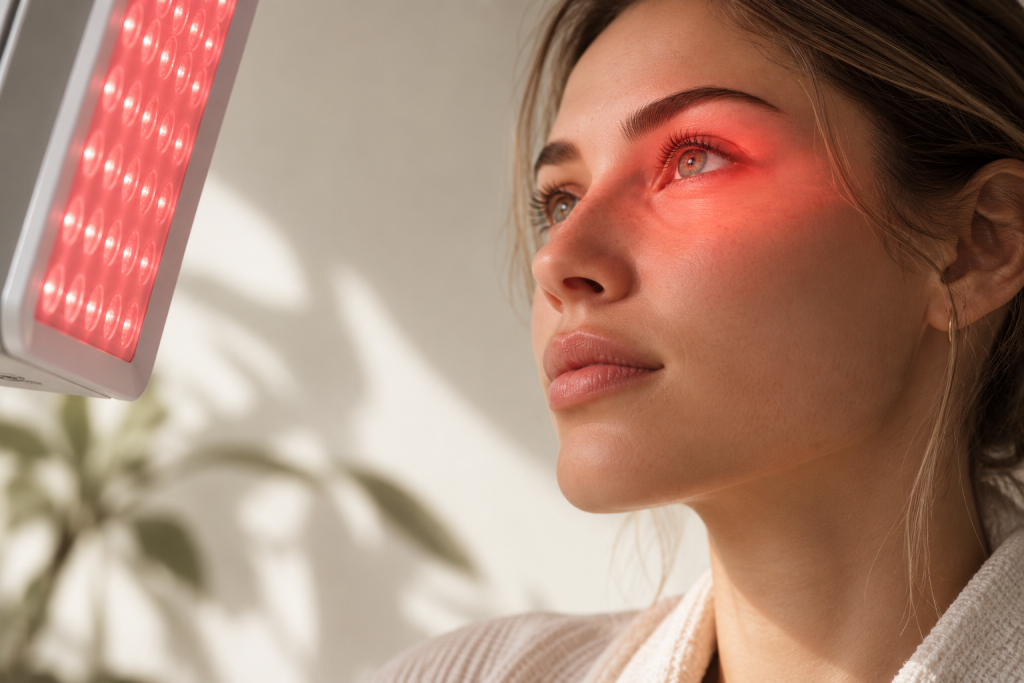
Do you feel constantly tired, even though you get enough sleep? Chronic fatigue syndrome (CFS) affects more and more people and often has no easy solution. However, scientists have come up with a promising finding— red and infrared light therapy can help alleviate some of the worst symptoms of this disease.
What is chronic fatigue syndrome?
CFS manifests itself as extreme fatigue that cannot be remedied even by long periods of sleep. People with this syndrome often suffer from muscle, joint, and head pain and have difficulty concentrating. The causes are not entirely clear, but it is often a combination of weakened immunity, impaired energy production in cells, and long-term inflammation.
In recent years, CFS has also been frequently associated with COVID-19, which can have long-term effects on the immune and nervous systems.
How can red light help?
Red and infrared light therapy (known as photobiomodulation) uses specific wavelengths of light that penetrate deep into the tissues. In cells, they stimulate mitochondria—the body's "energy centers"—to produce more ATP, i.e., energy.
This allows the red light to:
increase energy at the cellular level
reduce inflammation and thereby relieve pain
support the immune system
improve sleep quality and mental clarity
- relieve muscle and joint pain
What does science say about this?
Research in recent years confirms that photobiomodulation has real biological effects.
For example, a team of scientists from Harvard University (Hamblin, 2018) described how red light activates the enzyme cytochrome c oxidase in mitochondria, which improves cellular respiration and energy production.
Other clinical studies show that red light therapy can reduce pain and inflammation in people with chronic pain (Photomedicine and Laser in Medicine, 2012) and improve cognitive function and mood (Frontiers in Neuroscience, 2016).
New research is even investigating the effect of red light on "brain fog" and fatigue after COVID-19. Although this is not yet a treatment in the true sense of the word, the results are very promising.
Safe and non-invasive method
Photobiomodulation is considered a safe, non-invasive therapy that can be used as a supplement to conventional treatment. When used regularly, it helps not only people with CFS, but also those suffering from back and joint pain, injuries, or during recovery after sports.
Conclusion
Red and infrared light is not just a modern wellness trend. Thanks to its anti-inflammatory and energy-boosting effects, it offers a promising solution for those struggling with chronic fatigue.
You can read the entire article here:
RED INFRARED LIGHT AND CHRONIC FATIGUE SYNDROME
Sources:
Wood MS, Halmer N, Bertolli J, Amsden LB, Nugent JR, Lin J-MS, et al. (2024) Impact of COVID-19 on myalgic encephalomyelitis/chronic fatigue syndrome-like illness prevalence: A cross-sectional survey of
.
PLoShttps://doi.org/10.1371/journal.pone.0309810
Goldenberg D. L., How to understand the overlap of long COVID, chronic fatigue
syndrome/myalgic encephalomyelitis, fibromyalgia and irritable bowel syndromes, Seminars
in and Rheumatism, Volume 67, 2024, 152455, ISSN 0049-0172, https://doi.org/10.1016/j.semarthrit.2024.152455.
Source: https://www.sciencedirect.com/science/article/pii/S0049017224000957
Hamblin, M.R. Mechanisms of Photobiomodulation. Photochem. and Mitochondrial Redox Signaling in Photobiol. 2018, 94, https://pubmed.ncbi.nlm.nih.gov/29164625/
Fernandes KP, Souza NH, Mesquita-Ferrari RA, Silva DF, Rocha LA, Alves AN, Bussadori SK
(2015) Photobiomodulation with 660-nm and 780-nm laser on activated J774 macrophage-like
cells: effect on M1 inflammatory markers. J Photochem Photobiol B 153:344–351. Source:
https://pubmed.ncbi.nlm.nih.gov/26519828/